
Claiborne County VINELink Coverage
Tennessee uses VINE through the VINELink Tennessee portal. TDOC joined the service in 2021, and its announcement said many county jails already participated. Participation and agency feeds can change. For that reason, a live Claiborne County result should identify the reporting agency before anyone assumes the county jail is supplying the record.
A Claiborne County Jail result describes that county custody episode. A TDOC result describes state felony custody or supervision. The same name may have more than one record because the source agencies hold separate events. VINE may show a location, custody status, offender identifier, update time, and event information provided by the agency. It is built for one-person status checks and alerts, not for a county-wide list of everyone released during a set period.
The Tennessee portal also does not replace FOIL. FOIL includes current and former TDOC offenders and can expose sentence, parole, probation, and release information. VINE is strongest when someone wants notice of a future event. Both systems must be read by source agency and exact label.
Search Claiborne County VINELink Records
Start with the stable Tennessee state page. Search by a legal or committed name, or use an offender identifier when known. An ID reduces the risk of selecting a person with a similar name. Review every candidate before opening a record. Match only on details the interface lawfully displays, and give special weight to the reporting agency. A TDOC record is not proof of a Claiborne County Jail event.
- Open Tennessee in VINELink and choose the person or offender search presented by the live interface.
- Enter the person's legal name or known offender ID. Try a known alias only if the first search fails.
- Compare candidates using the agency and permitted identifying facts, not name alone.
- Open the matching record and copy the exact custody status, source agency, and last-update wording.
- Check any destination or transfer detail before calling the event a community release.
The official portal image shows the Tennessee search entry point. Open the live Tennessee VINE search because labels and available actions can change.
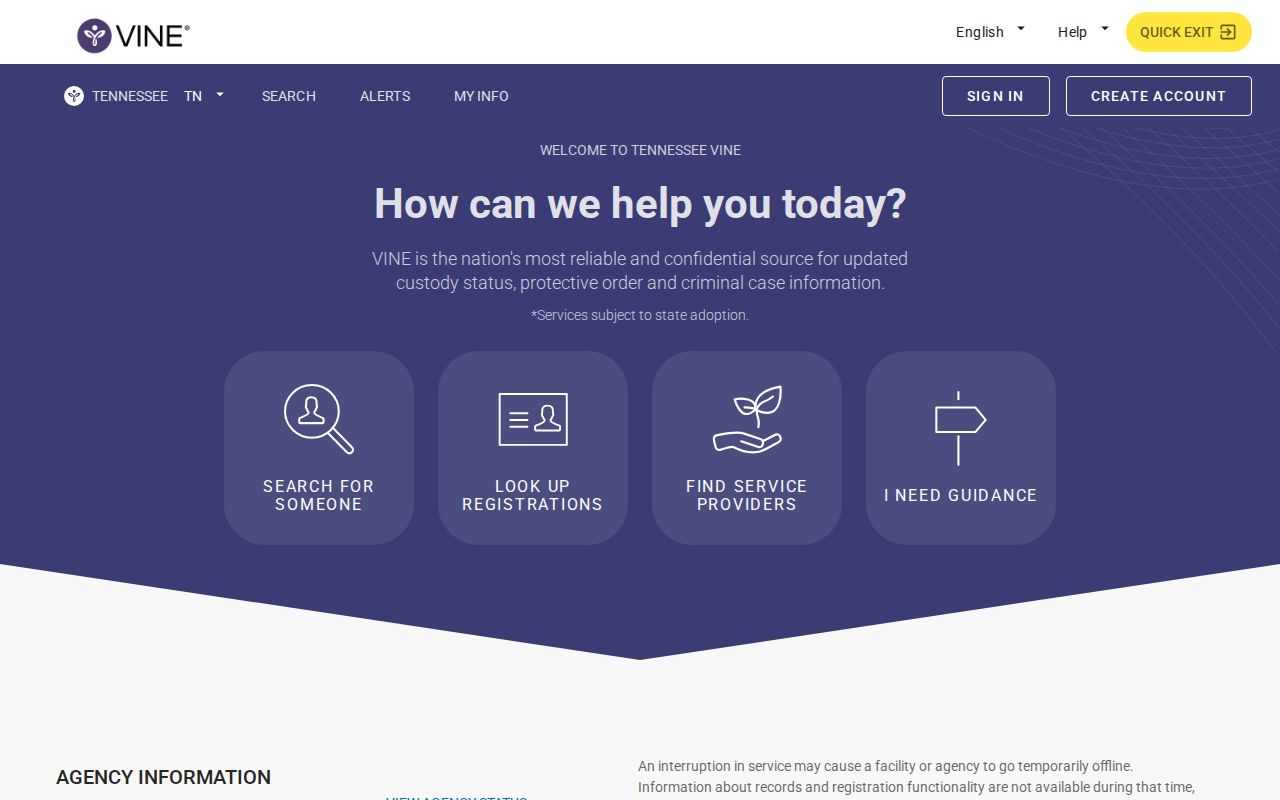
The screenshot identifies the state service, while the live result must supply the current agency, status, update time, and notification options for the chosen person.
Multiple matches call for care. Do not assume the first name is correct. If no record appears, retry with the ID or a known spelling, then contact the last known custodian. A no-result may reflect a spelling issue, data lag, an agency feed limit, or a custody type that VINE does not cover.
Claiborne VINELink Release Fields
Read the field labels as written. A status supplied by Claiborne County concerns the jail event reported by that agency. A TDOC status concerns state custody or supervision. “Released” can confirm that a named agency closed its custody episode, but it does not rule out a transfer to TDOC, another jail, federal custody, or ICE. Likewise, a scheduled event is not proof that physical release occurred.
| Field | How to read it |
|---|---|
| Reporting agency | Identifies whether the result belongs to Claiborne County, TDOC, or another participating source. |
| Custody status | Use the exact live wording. Do not turn a blank or no-result into a release claim. |
| Location | Shows the reported facility or agency location when supplied, not necessarily the county of conviction. |
| Offender ID | Helps distinguish people with the same or similar names. |
| Update time | Shows when the visible record was refreshed and helps expose possible lag. |
| Event or date | May describe a release, transfer, or scheduled event. Its label controls the meaning. |
A photograph can help distinguish candidates if the agency supplied one. It does not establish release, disposition, or present location by itself. For a durable Claiborne County release confirmation, compare the VINE event with the sheriff's release record and the local court order. For a TDOC event, compare it with FOIL or a TDOC release record.
Note: Save the source agency, exact status, and retrieval time together because a copied date without its label can easily be misunderstood.
Register Claiborne Release Notifications
Registration begins from the correct person's record. Select only the event types and contact methods offered by the live interface. Tennessee's launch notice identifies phone, email, TTY, and text options, while app functions may also appear. VINE notifications are free and confidential according to TDOC. A user's phone or data plan may still carry its normal service costs.
- Open the confirmed record and select “Register,” notifications, or the comparable live control.
- Choose release, transfer, custody-change, or other offered events that fit the need.
- Select telephone, text, email, TTY, or app when available, then enter the destination carefully.
- Create the requested PIN for telephone verification and repeated-call control when prompted.
- Complete any email link or text code, then save the confirmation in a private place.
- Return to the record or service controls when the notification must be changed or stopped.
Never publish a PIN, telephone number, or email address used for registration. A missed confirmation step may leave the alert inactive. Tennessee also provides live VINE operator support at 888-868-4631 around the clock, according to TDOC's launch announcement.
Note: Keep the private confirmation, then revisit the correct record if an expected alert does not arrive or the contact route changes.
Confirm Claiborne VINELink Release Alerts
An alert is secondary to the reporting agency. Data transmission can lag. A transfer may first look like the end of one custody record, and a spelling mismatch can hide the expected result. VINE itself should not be the only measure used for an urgent safety choice. Contact law enforcement for an immediate safety issue. For record verification, ask the agency that supplied the entry.
Limits: A no-result does not prove release, a scheduled alert is not actual release, and a county alert does not rule out transfer to another custodian.
For Claiborne County Jail, ask whether the person was released to the community or transferred, and request the date, time, authority, and destination shown in the existing release record. The official Claiborne County Sheriff page supplies its current main-office channel. The local court clerk can then provide the bond, dismissal, probation, sentence, or other order behind the event. The full sequence is available through the Claiborne County released-inmate lookup.
For a state felony offender, use TDOC's FOIL overview and search route. FOIL may show current or former status, location, sentence information, parole or probation, and release information. A county result and a TDOC result should not be merged into one event.
Claiborne VINE and Agency Notices
VINE supplements agency records and notices. TDOC's launch announcement describes its written notification system as covering location, transfer, sentence expiration, release, and parole eligibility information, with VINE adding search and electronic registration. The two channels may not use identical timing or labels. Keep each notice with its source and date instead of blending them into a single timeline.
A release alert is most useful when the person and agency were matched before registration. If the tracked record came from Claiborne County Jail, confirm the event with the sheriff. Ask whether the exit was to the community, another jail, TDOC, USMS, or ICE. If the tracked record came from TDOC, check FOIL and the state release record. The reporting source determines which office can correct an error.
Notifications can also arrive after a data delay. Record the time received, then compare it with the agency's release date and time. A later booking or a second charge may create a new custody event that the first alert does not address. The Claiborne County court docket can explain a bond, dismissal, probation order, sentence, or revocation, but the court may not have the jail's exact door-out time.
For future alerts, retain the registration confirmation and keep the contact route current. For a past event, request the underlying record. VINE is a notification tool, not a historical certificate. That boundary matters when an older Claiborne County result disappears or the live page no longer exposes the prior status.
A person can also move from one reporting system to another on the same day. Claiborne County may close its jail event when transport begins, while TDOC or a federal agency opens a new custody event later. During that gap, a release alert can be accurate about the county record but incomplete about the person's full status. Ask for the destination or receiving agency shown in the sheriff's release entry. Then search the new custodian by its own identifier and rules. This two-source check is especially important when a detainer or transfer order appears in the local record.
Claiborne Release System Boundaries
VINELink is not the federal Bureau of Prisons locator. A person serving a federal sentence should be checked through the BOP system, which may show a released status or release date. A recent federal pretrial detainee may remain under U.S. Marshals Service responsibility and may never appear as a BOP prisoner. The federal court or the proper USMS district is then the better route.
Immigration detention also has its own system. A person can leave Claiborne County Jail on an ICE detainer and enter federal civil immigration custody. That is a transfer, not a community release. Search ICE by A-number and country of birth or by the available biographical path. No dedicated ICE detention facility was verified in Claiborne County.
Post-release registries form another narrow branch. The TBI Sex Offender Registry applies only to people with a statutory registration duty. Its absence does not say anything about an ordinary release. The TBI Drug Offender Registry is also limited to qualifying convictions. Neither is a substitute for VINE, FOIL, or the sheriff's release record.
Note: Match the search system to the custodian, since county, state, federal, immigration, and registry records answer different questions.