
Claiborne Parole Versus Probation
Parole is conditional release from a Tennessee prison sentence before its expiration. The Tennessee Board of Parole decides whether an eligible state felony offender receives it. TDOC then handles field supervision. Probation is imposed by a court. It may be the full community sentence, follow a short jail term as split confinement, or arise through a determinate-release certificate for an eligible sentence. In both cases, the person lives in the community but must comply with lawful terms until discharge, revocation, or sentence completion.
The Claiborne County Sheriff does not decide statewide parole and does not supervise state probation. A person can leave Claiborne County Jail on probation, but the court order identifies the legal basis and TDOC may manage felony supervision. A parolee has left institutional custody only after the approved release plan and certificate process is complete. These distinctions keep a supervision inquiry tied to the office that owns the record.
| Point | Parole | Probation |
|---|---|---|
| Who authorizes it | Tennessee Board of Parole for an eligible prison sentence | The sentencing court, with determinate release available in qualifying cases |
| Prior confinement | Follows prison custody | May occur without prison, after jail, or after split confinement |
| Public first check | FOIL status, sentence, and parole information | FOIL for TDOC cases plus the Claiborne County court order |
| Local supervision route | TDOC District 20 Community Supervision in New Tazewell when that office is assigned | |
- Discharge
- The formal end of supervision or sentence responsibility, not merely release from a jail or prison.
- Revocation
- A legal process that may cancel community release after a proven violation and may return the person to custody.
- Absconder
- A supervision status alleging that a person failed to remain available or report as required.
- Determinate release
- A statutory community-release route for certain felony sentences, with TDOC issuing the certificate.
Verify Claiborne Post-Release Supervision
The public starting point is TDOC's Felony Offender Information Lookup, known as FOIL. It covers people currently or formerly in TDOC custody or under TDOC supervision. A TOMIS identifier produces the cleanest match. A name search can work, but similar names make the displayed birth and case details important. Read the exact status. “Probation,” “parole,” and “inactive” do not mean the same thing, and “inactive” needs sentence or expiration context before it can be treated as a completed supervision record.
- Search FOIL by TOMIS ID, or use the committed name and compare permitted identifying details.
- Open the correct record and note its exact status, location, sentence rows, and parole information.
- Check the Claiborne County judgment or probation order with the Circuit and General Sessions Clerk when the sentence began in local court.
- Use TDOC's field-office directory to identify the office assigned to the supervision record.
- Ask only for publicly releasable confirmation of active probation, active parole, inactive, absconded, revoked, or another listed posture.
A person missing from FOIL may have only a misdemeanor or brief county booking. FOIL is not a full Claiborne County jail archive. In that case, the sheriff establishes the release event and the Claiborne County clerk's docket shows the order. The Claiborne County released-inmate search path explains how those two local records fit together.
Important: Community supervision means the person has left institutional custody. It does not establish that every charge, hold, or separate case has ended.
Claiborne Supervision in New Tazewell
Claiborne County has a named local state supervision route. The TDOC New Tazewell Field Office is part of District 20 and serves Claiborne, Hancock, and Union Counties. It is not a jail, roster desk, or walk-in inmate locator. Call before visiting. Give the person's name and TOMIS ID when known, then ask which office holds the case and what supervision status can lawfully be confirmed. Do not request a private home address, supervision plan, or other protected details.
TDOC New Tazewell Field Office
129 South Broad Street
New Tazewell, TN 37825
423-851-5282
Fax: 423-526-9882
The official directory image shows where District 20 supervision inquiries are routed. Review the TDOC Community Supervision directory before calling.
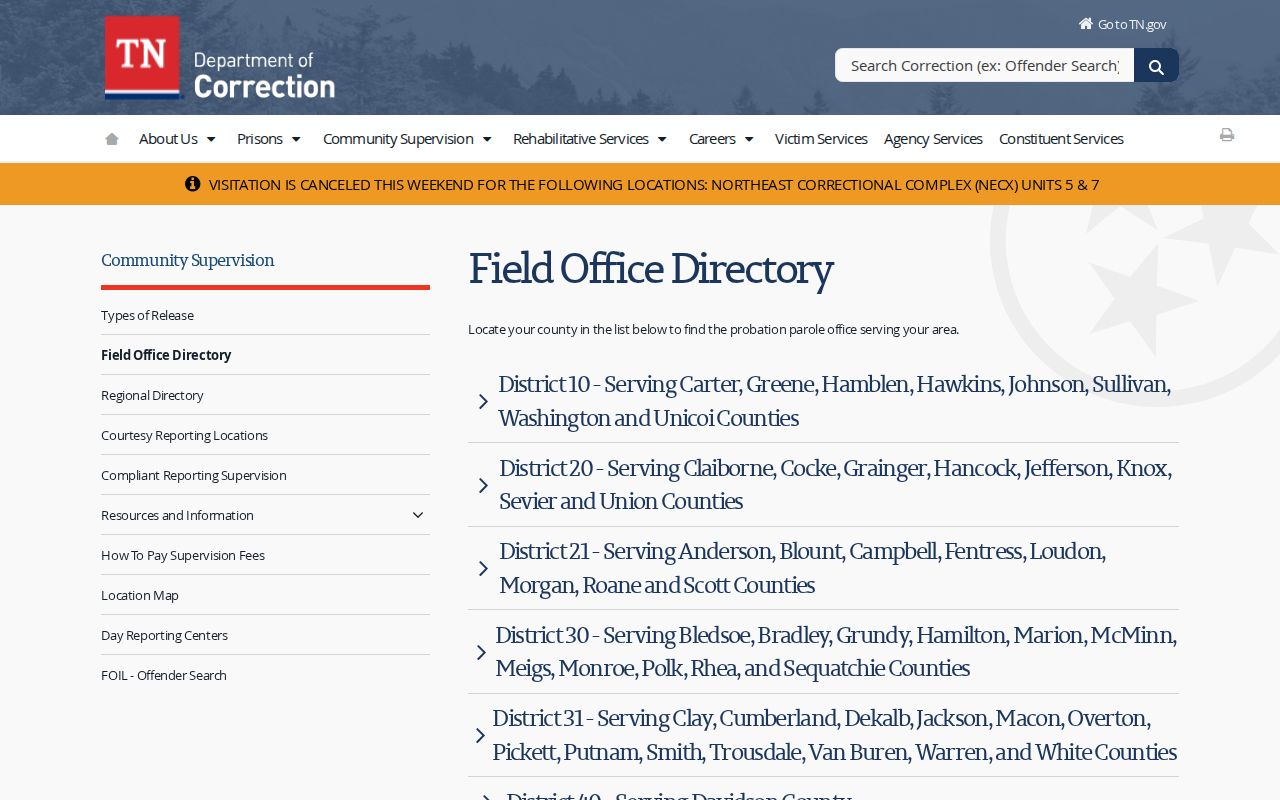
This source confirms the local office's multi-county service area and keeps a Claiborne supervision inquiry from being sent to the jail.
Hearing decisions remain with the Board, not this field office. The Board's central office and East Tennessee regional hearing office handle different parts of the process. For a final decision or a schedule issue, use the Board channel. For field supervision routing after release, use TDOC.
Note: Published field-office details identify the proper agency route but do not guarantee that staff can disclose every fact about an individual case.
Claiborne Absconder and Violation Records
No official Claiborne County public absconder list was found in the research sweep. A crowd-sourced list should not take its place. If FOIL shows an absconder, revoked, or other supervision status, read it as an agency record that needs current confirmation. An absconder label alleges failure to remain compliant or available. It does not erase the earlier release from confinement, and it does not by itself prove a fresh arrest.
Conditions vary by the order and supervision plan. At a high level, they can require reporting, lawful conduct, approved movement, program participation, or other case-specific duties. A claimed violation moves through a formal process. A preliminary revocation hearing addresses probable cause. A final revocation hearing decides the alleged breach and may lead to return to custody, reinstatement, or another lawful outcome. The Claiborne County court docket can also contain probation-violation filings and resulting orders.
VINE can notify a registered user about custody changes reported by a participating agency, but it is not a public supervision-case file. A release notice, transfer alert, or no-result does not answer whether probation or parole is active. FOIL, TDOC, the Board, and the court record remain the proper checks.
Claiborne Parole Hearings and Release
A parole calendar records a proceeding, not a release. The Board says county-jail and state-prison schedules are updated weekly, generally on Monday or Tuesday after a Monday holiday, and remain subject to change. A Claiborne County Jail entry may appear on the county-jail schedule even though no state prison is located in the county. Search the schedule based on the person's physical location, not merely the county where the conviction occurred.
Proceedings can include an initial hearing, review, preliminary or final revocation hearing, rescission hearing, custodial hearing, or time-setting hearing. A hearing officer may make a non-binding recommendation. Board members issue the final parole decision. Outcomes can include a grant, denial, deferral, revocation, reinstatement, or rescission. Ask for the final disposition if no stable results portal displays it.
The Board's parole-hearing information is the official source for hearing types and procedure. Even a grant does not prove that a person walked out. The Certificate Unit prepares the parole certificate only after a grant and an approved release plan. FOIL, VINE, or the TDOC release record must then confirm the release date.
Note: A scheduled hearing and a favorable recommendation are steps in a process, not proof of completed release from custody.
Fresh Start Before Claiborne Release
Claiborne County's Fresh Start and Jail-to-Work program creates an unusual status question. County financial records say the program began after the jail was declared a workhouse in 2019. A later sheriff report describes vetted participants leaving custody each day for approved activity. Those trips are authorized movement, not final discharge. Someone seen outside the secure jail can still be legally confined.
The same county report describes participant funding being released upon final release. That separate event helps mark the difference between a workday outside the jail and the end of legal custody. Confirm the latter through the jail release record and the underlying court order. If probation follows, the court and TDOC supervision record show the next legal phase.
The May 2024 county sheriff report provides the local program detail. It does not function as a live supervision database, so names and current status must come from the proper custodian.
Note: Daily Jail-to-Work movement does not end custody; the jail record and court order must show the final release.
TDOC Release Property and Identification
A state-prison release involves more than a date. TDOC maintains policies on release procedure, personal property, trust funds, and preparation for a Tennessee driver license or state identification. TDOC Policy 511.03 addresses release-day authorization and checks. That process belongs to TDOC, not the Claiborne County jail or the New Tazewell field office.
When a date or status is disputed, request the TOMIS sentence and release record. The record can identify release authorization, date, type, and the transition into supervision. Do not ask the county sheriff to alter a state sentence calculation. Likewise, release property paperwork should not be treated as proof that parole supervision has ended. Physical release and final discharge are separate events.
When Claiborne Supervision Ends
Supervision ends through the lawful event shown in the sentence, court order, or TDOC record. It may end at sentence expiration, through a formal discharge, or after another authorized case outcome. An “inactive” FOIL label can be useful, but its meaning should be checked against the sentence and release fields. A person can be free from jail while active on parole or probation, and can later be free from supervision after discharge.
The Tennessee Public Records Act provides a route to request public records from the custodian. It does not require an office to create a new analysis. If FOIL lacks the needed historical field, request the sentence summary, supervision status, release authorization, or archived record from TDOC. The Claiborne clerk remains the source for the local judgment, probation order, or violation disposition.
Keep the question narrow. Ask whether the public status is active or inactive, which office is assigned, and what date the public record gives for discharge. That approach respects protected supervision details while obtaining a usable answer.