
Claiborne Projected Versus Actual Release
Tennessee uses several dates. A judge imposes the sentence and offender range or classification. TDOC calculates the Release Eligibility Date, often shortened to RED, for a state case. The Board of Parole decides discretionary parole when the law permits it. TDOC also calculates sentence expiration and prepares release paperwork. For a local sentence, Claiborne County Jail implements the judgment with jail credit, sentence credits, court orders, and holds.
A RED is the first point at which the governing law may permit parole or another qualifying release route. It is not an appointment at the prison gate. An expiration date is the calculated end of the sentence under the applicable law. An actual release date records when custody ended with that agency. Each answers a different question, so the source label must remain attached to the date.
Scheduled versus actual: A projected or eligibility date can change. Only the responsible custodian's completed release record proves the physical release event.
A pretrial detainee is different. No sentence has yet created a computed expiration or RED. Release turns on bond, recognizance, dismissal, a later judgment, or another court action, plus any outstanding hold. Ask the Claiborne clerk for the court order and the jail for the final custody event.
Find a Claiborne Inmate Release Date
First identify the custodian. A Claiborne County booking, local misdemeanor sentence, and TDOC felony sentence do not share one calculator. A person convicted in Claiborne County may serve state time elsewhere, while someone in the county jail may be pretrial or serving a local term. Start from the last known custody type, then use the office that owns that record.
- For a Tennessee felony case, search FOIL by TOMIS ID or committed name and open the correct record.
- Copy each displayed field exactly, including status, RED, expiration, sentence rows, and location. Do not merge dates from separate sentences.
- For a county sentence, request the judgment and jail-credit details from the Claiborne Circuit and General Sessions Clerk.
- Ask the jail for the existing calculation or release record and whether a detainer, transfer order, or other hold affects community release.
- If a FOIL field is missing, request TDOC's sentence summary, calculation, or release authorization by TOMIS record.
The TDOC FOIL overview confirms that the system covers current and former TDOC offenders and may show sentence and release information.
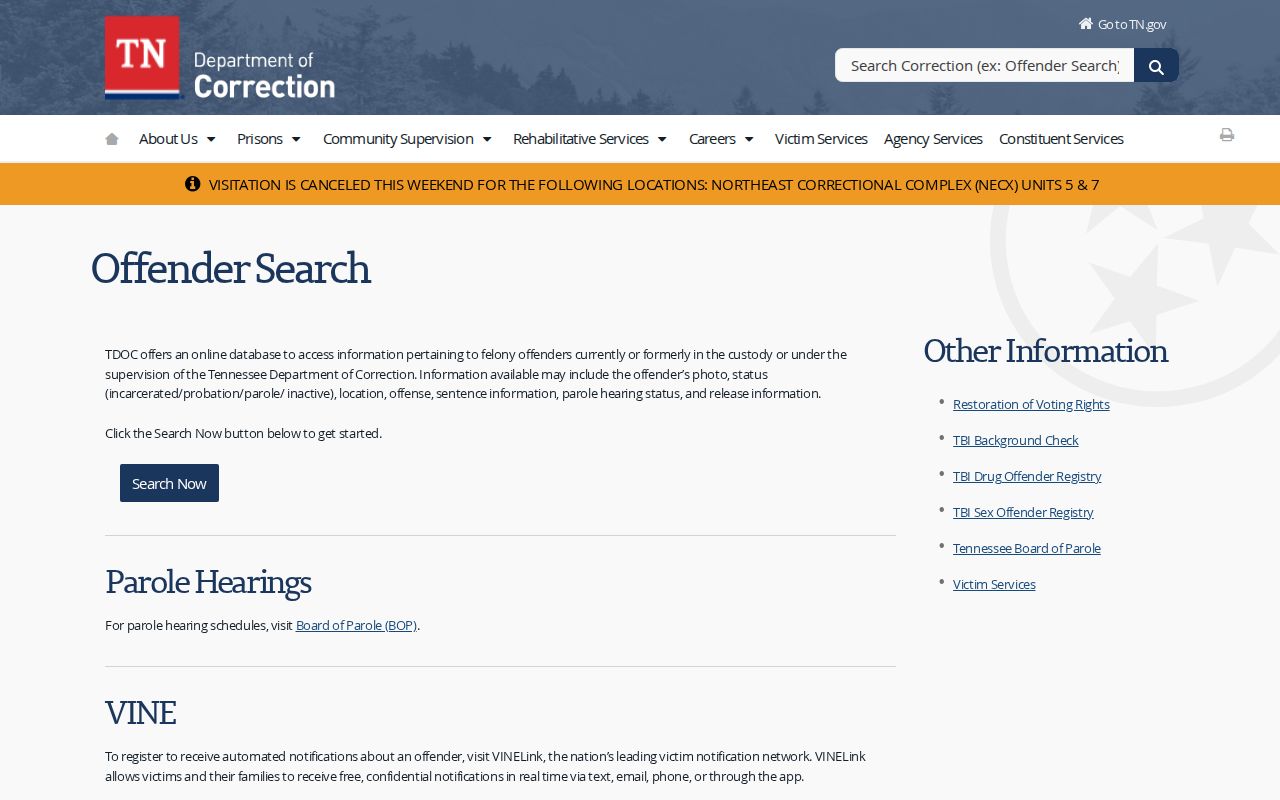
The image establishes FOIL's scope. The live individual record controls which date fields and status are actually available for a specific Claiborne County offender.
FOIL does not cover every brief jail stay or misdemeanor. If the case never entered TDOC custody or supervision, use the sheriff and clerk. The Claiborne County release-record process shows how the physical jail event and court authority can be reconciled.
Tennessee Credits and Claiborne Release Dates
TCA § 41-21-236 authorizes sentence-reduction credits for good institutional behavior and satisfactory program performance when the person, program, and governing sentence qualify. The researched framework generally allows one to sixteen days per month, with up to eight tied to each category. Credits can be withheld for a disciplinary month. Previously awarded credits can also be removed for a major infraction through the required process. They must be earned and retained, not assumed in advance.
The statute extends its framework to qualifying felony offenders serving in local jails or workhouses, with the jail administrator filling the role assigned to a warden. Pre-sentence good-behavior credit may also be recommended under the relevant subsection. For a local misdemeanor, the court fixes a service percentage within the statutory increments, and the application of credits cannot reduce that release percentage by more than the statutory limit. The actual Claiborne calculation needs the judgment, custody start date, jail credit, sentence alignment, disciplinary credit record, and holds.
Sentence alignment matters. Concurrent sentences run together, while consecutive sentences run one after another. A new consecutive judgment can move the controlling date even if an earlier sentence row does not change. A detainer can also prevent community release after one sentence ends. That is why a single date copied without the full sentence record may give a false answer.
Note: No published Claiborne County good-time policy or county-specific weekend-release rule was located, so ask the jail for the governing current calculation.
Why Claiborne Release Dates Change
A displayed inmate release date can change for legal, disciplinary, or clerical reasons. A change does not always mean that someone made an error. It may reflect a corrected judgment, added jail credit, a new sentence, loss or restoration of credit, a parole decision, or a hold from another authority. Compare the new field with its capture date and the source that made the update.
| Factor | Possible effect | Best record |
|---|---|---|
| Corrected judgment or jail credit | Changes the sentence calculation or starting credit | Claiborne court order and TDOC or jail calculation |
| Consecutive sentence | Moves the controlling end date later | Judgment and complete sentence summary |
| Credit award, loss, or restoration | Can change eligibility timing under the applicable law | TDOC or jail disciplinary and credit record |
| Parole denial or deferral | Keeps actual release later than the first eligible point | Final Board decision and FOIL |
| Detainer or hold | Can lead to transfer instead of community release | Custodian release record and receiving-agency confirmation |
| Revocation or new case | May return the person to custody or add new time | Court, Board, TDOC, and current custodian records |
| Administrative correction | Changes an inaccurate or incomplete public display | Dated agency record and sentence calculation |
Parole adds another step. A Board grant still precedes approval of the release plan and issuance of the parole certificate. It does not prove the actual date that institutional custody ended. A VINE notice or TDOC release record should confirm the event after the certificate process.
Note: Compare each changed date with the new source record instead of assuming that the first public value remains controlling.
Post-2024 Tennessee Date Labels
Research Section 19 highlights a Tennessee-specific date problem. For offenses and sentences affected by the law after July 1, 2024, credits may affect parole eligibility without changing sentence expiration. Section 41-21-236 distinguishes short sentences from longer ones. For qualifying longer sentences, sentence-reduction credits can move the point before parole eligibility but do not move the expiration date.
The related eligibility law is TCA § 40-35-501. Ordinary ranges have historically included different percentages based on offender classification, but those rates do not govern every crime. Life, violent, sexual, and other listed offenses can have distinct rules. The offense date and exact subsection are crucial.
The phrase “serve 85 percent” is not a rule for every Tennessee inmate. For certain listed offenses committed within specified date ranges, the statute sets an 85-percent framework with detailed treatment of retained credits. Other listed offenses can carry 100-percent service provisions. A search result must never apply one percentage to all Claiborne County cases.
This difference is why RED and expiration must stay separate. Do not rename either one “guaranteed release.” Ask which offense-date version applies, which credits are included and retained, and whether the case involves discretionary parole, determinate release, mandatory supervision, or full expiration.
Note: The offense date and exact statutory subsection control; no single Tennessee percentage applies to every Claiborne County sentence.
Claiborne County Date Source Records
The sheriff, court clerk, TDOC, Board of Parole, and VINE each own a different slice of the answer. The Claiborne County Jail record establishes the local physical custody event. The Circuit and General Sessions Clerk keeps the judgment, sentence alignment, jail-credit terms, probation order, or later revocation action. TDOC owns the state sentence calculation and release authorization. The Board decides discretionary parole. VINE republishes an agency status or event for notification.
For a local sentence, ask the sheriff for the existing booking and release record and the clerk for the judgment. A good request identifies the full committed name, date of birth, booking date and number when known, and case number. Ask for the release date and time, release authority, destination, and any publicly releasable hold or receiving-agency field. A transfer is not a release to the community.
For a state sentence, the TOMIS ID anchors the search. Review all sentence rows because concurrent and consecutive cases can produce more than one eligibility or expiration date. The top-line status alone may not reveal which sentence controls. A parole or probation label means institutional custody has ended, but state supervision remains. An inactive label needs the supporting release or expiration context.
The Claiborne County clerk's official office is at 415 Straight Creek Road, Suite 5, New Tazewell, TN 37825, with telephone 423-626-3334. The clerk can identify the case and disposition, but may not know the exact physical exit time. That timestamp remains with the jail. Using both records avoids treating a court order as proof that no other hold delayed release.
Under Tennessee's public-record framework, a custodian can provide an existing record but need not create a new calculation or answer a broad question. Ask for the sentence summary, credit record, or release authorization that already exists. Request a cost estimate before copies or archive work. If part of a record is exempt, ask for the segregable public portion.
Confirm a Claiborne Release Date
Save the FOIL detail with its retrieval date. Then obtain the Claiborne County judgment when the prosecution began locally and request the current sentence summary or calculation from TDOC. Useful questions are direct: What is the current RED? What is the current expiration date? Which release percentage applies? Which credits have been earned and retained? Does another hold prevent release to the community?
TDOC archived records can be requested through its portal or from Records Management at the Rachel Jackson Building, Second Floor, 320 Sixth Avenue North, Nashville, TN 37243-0465. The published records telephone is 615-253-8079. Ask for the sentence summary, release eligibility calculation, expiration calculation, release authorization, release date and type, and public supervision status tied to the TOMIS record. TDOC says archive costs are quoted after completion, so do not prepay.
For a future event, register through the Claiborne County VINELink Release Check. The alert remains secondary to the jail or TDOC record and cannot rule out a transfer. For a local case, use the official Claiborne County Sheriff contact and ask whether the person left for the community or another custodian. For a state case, compare VINE with FOIL and the TDOC release document.
Final check: Record the source, field label, retrieval time, and agency. Reconfirm near the expected date because credits, holds, and orders can change.